
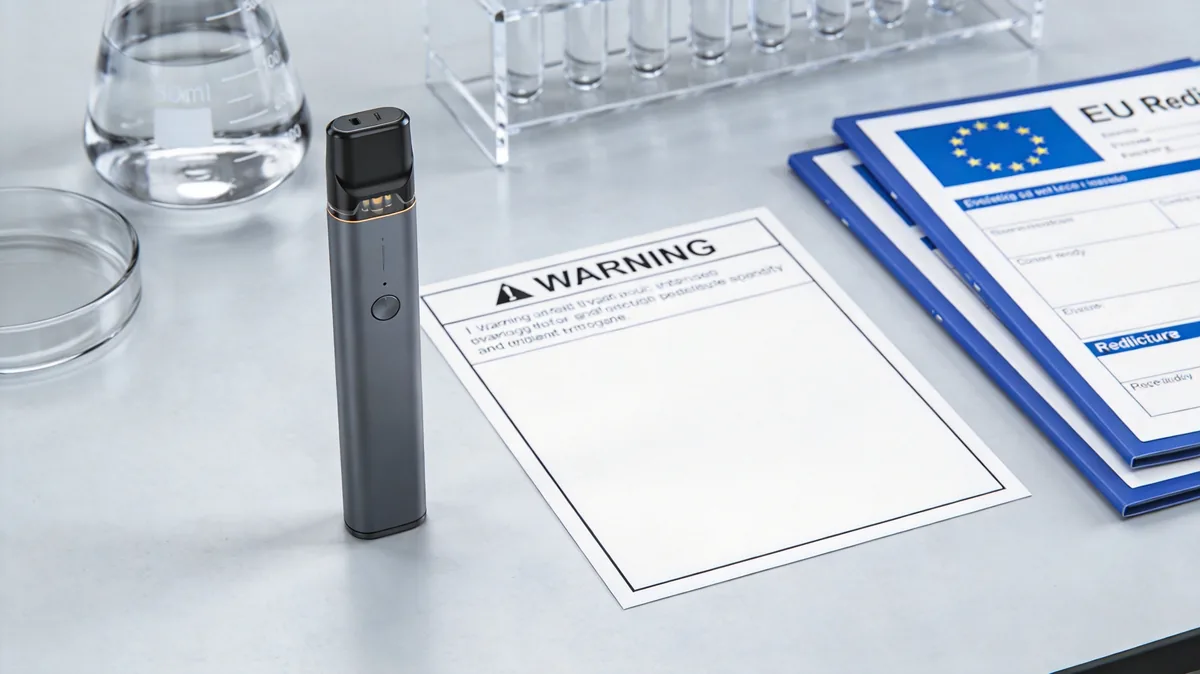
Compliance is not a marketing badge. It is a set of documents, labels and restrictions a retailer has to verify before stock reaches the shelf.
“EU market standard” is one of the most repeated — and least examined — phrases in European vape wholesale. For a B2B buyer, treating it as a checkbox is a genuine commercial risk: the products, the packaging, the advertising and even the legality of the category itself can all differ between member states. This article explains what the Tobacco Products Directive actually requires, where it ends and national rules begin, what “TPD compliance testing” does and does not prove, what paperwork to request from a supplier, and how to build a repeatable compliance check into every purchase. It is general information, not legal advice; national authorities and qualified counsel are the authoritative source for your market.
What the TPD actually is
The Tobacco Products Directive (Directive 2014/40/EU, universally called the TPD) is the EU-wide framework governing, among other things, e-cigarettes and refill containers. It sets a baseline that every member state had to write into national law.
A framework, not a single rulebook
The most important practical consequence for a buyer: the TPD is a floor and a framework, not a single identical rulebook enforced identically everywhere. Each country transposes and enforces it through its own authority, and several have layered stricter or entirely separate rules on top — most visibly for disposable devices. Two member states can therefore both be “EU market standard” while permitting quite different products.
What the TPD does not cover
The TPD does not decide flavour restrictions, it does not set retail licensing, and it does not settle national bans. Those sit with member states. Keeping that boundary in mind prevents the common mistake of assuming that a product’s TPD status alone makes it sellable in your market.
The core product requirements buyers should know
For nicotine-containing e-cigarettes and refill liquids sold in the EU, the framework covers a defined set of technical and labelling requirements. The table below summarises the baseline that matters at wholesale level, and pairs each requirement with what you should be able to obtain from your supplier.
| Requirement | TPD baseline | What to request from your supplier |
|---|---|---|
| Nicotine concentration | A ceiling of 20 mg/ml for nicotine-containing e-liquid. | Specification or batch sheet stating the nicotine strength per millilitre for the exact SKU. |
| Refill container volume | A limit of 2 ml for refill containers and, where applicable, device reservoirs. | Confirmed liquid volume for the device or pod as shipped, not the marketing “capacity” figure. |
| Health warnings | Mandatory nicotine-addiction warning and accompanying information on packaging. | Label artwork in the language of your market of sale, before you commit to volume. |
| Child resistance & tamper evidence | Required on packaging and containers. | Manufacturer declaration or certificate covering the packaging actually supplied. |
| Ingredient & emission data | Manufacturers must compile ingredient and emission information for their products. | The submission reference or notification ID associated with the product. |
| Notification before market placement | Products must be notified in each member state before being placed on that market. | Confirmation of the countries for which this specific SKU is notified. |
The number on the box — a printed “TPD” logo or a claim of compliance — proves nothing on its own. Compliance lives in the underlying notification, documentation and the product actually matching the notified specification. For the two limits buyers ask about most often, see the 20 mg/ml nicotine limit explained and the 2 ml tank and reservoir limit explained.
What “TPD compliance testing” actually covers
Search for TPD compliance and you will quickly meet the phrase “compliance testing”. It is a genuine part of the system, but it is narrower than many buyers assume — and understanding its scope is one of the fastest ways to tell a substantiated supplier from a confident one.
Emissions, ingredients and the test report
Under the framework, manufacturers are expected to have product information covering the ingredients used and the emissions the product produces when used as intended. In practice this arrives in the form of an analytical report or a set of test summaries covering the e-liquid composition and the aerosol a device produces. Those reports are assembled by the manufacturer or an appointed laboratory, then used to support the notification dossier submitted in each market.
What a test report does not prove
A test report is a point-in-time statement about a specific sample. It does not prove that later production runs match that sample, that the device has been notified in your country, that the labelling meets your language requirement, or that the product is legal to sell given current national flavour and disposable rules. It is one supporting document, not a licence. Treating a PDF as a blanket permission slip is exactly the mistake that leads to seized or unsellable stock.
How to read the documentation you are sent
- Check the identifier. Does the document name the exact model or SKU you are buying, or a generic family name that covers several products?
- Check the date and scope. When was it issued, and does it cover the nicotine strength and liquid volume actually being shipped to you?
- Check who issued it. A manufacturer or accredited laboratory carries different weight from an unattributed internal sheet.
- Check it against the goods. The most common real-world failure is not a missing document but a delivered product that does not match the notified specification.
Notifications and the role of the manufacturer
Under the framework, manufacturers and importers carry the primary obligation to notify products and provide the required information before placing them on a national market. As a downstream retailer you do not normally perform that notification yourself, but you are commercially exposed if the product you bought was never properly notified for your country or does not match what was notified. That is why B2B due diligence means asking for evidence rather than accepting an assurance.
Reasonable requests to a wholesale supplier include the exact product identifier and specification (device model, e-liquid volume, nicotine strength, battery capacity), confirmation of the market(s) for which the product is notified, the responsible economic operator for the product, and labelling that matches the destination country. A supplier serving EU trade buyers should be able to answer these questions for each line. Vagueness or refusal is itself data. The mechanics of the EU-wide notification portal are covered separately in EU-CEG notification for disposable vapes.
Where national law takes over: flavour and disposable rules
This is the area that has caused the most disruption to the disposable category. Several member states have adopted national measures restricting or prohibiting flavoured products or disposable devices outright, and the precise scope, timing and enforcement posture differ from one country to another. A device that is fully compliant and freely sold in one member state can be restricted or banned in a neighbouring one, regardless of TPD conformity.
Because this landscape changes, do not rely on a blog post — including this one — for the decisive answer. Before ordering a product for a specific market, check the current position with that country’s competent authority (for example the public health or medicines authority responsible for tobacco/e-cigarette enforcement) or with qualified counsel. Responsible suppliers will also tell you clearly which markets they will and will not ship a given SKU into. For the retailer-facing version of this, see the EU disposable vape bans retailer checklist and TPD regulation updates for 2026.
What correct labelling looks like
Packaging for a compliant nicotine product should carry the required warning text, nicotine content information, ingredient and adverse-effect information channels, and appropriate child-resistant, tamper-evident presentation. Language is a national matter — warnings and information typically have to be in the language of the market of sale. If you receive bulk stock whose labelling is in the wrong language for your country, the product is not shelf-ready even if every technical requirement is met.
When goods arrive, compare the physical packaging against the specification you were given: brand and model, nicotine strength, liquid volume, batch markings and warning text. A mismatch between what was sold as notified and what arrives is the single most common compliance failure in practice. The packaging requirement that is changing soonest is covered in child-resistant packaging for vapes and the October 2026 deadline.
Age, advertising and your responsibilities as a seller
TPD compliance does not end at the product. National laws govern age verification (sales to under-18s are prohibited), cross-border distance sales, advertising and product presentation. Online retailers in particular should operate a genuine age gate at entry and an age check at purchase, keep nicotine-containing products clearly separated from any youth-oriented presentation, and avoid health or cessation claims that are not authorised. On estvape the trade catalogue is presented to adult B2B buyers precisely because the downstream retail environment carries these obligations.
When a “EU market standard” claim does not hold up
Most compliance failures are not fraud; they are gaps between a broad claim and a specific product. These are the patterns that repeatedly show up when a buyer checks properly:
- The claim is generic. “Our products are EU market standard” describes a supplier’s intent, not the status of the SKU in your cart.
- The documentation names a family, not the SKU. A report for a product line does not cover every variant, strength or volume inside it.
- Notification is claimed for the EU rather than for your country. Notification is a per-market obligation; “notified in the EU” is not an answer.
- The label language does not match the market. Technically compliant product can still be unsellable as delivered.
- National rules changed after the last check. Flavour and disposable restrictions have moved repeatedly, and a compliant order placed last year can be non-compliant today.
None of these require bad faith to happen — which is precisely why a documented, repeatable check beats a one-time reassurance.
A buyer’s compliance checklist
- Identify the exact SKU and specification and confirm it matches the physical product and packaging.
- Confirm the market: is this product notified and permitted in your specific country, including current disposable and flavour rules?
- Request documentation for notification status, responsible operator and product specification, and keep it on file.
- Check labelling language and warnings for your market before accepting the goods as shelf-ready.
- Verify age-gating and sales controls in your own channel.
- Re-verify periodically — national rules in this category move quickly, and a legal SKU today can be restricted next season.
The cheapest compliance process is the one done before the order, not after stock arrives. If you need product documentation for specific lines or confirmation of which markets a product can be supplied into, use the B2B registration page or the wholesale FAQ, and always confirm your national position with the competent authority before scaling an order.
FAQ: TPD compliance for wholesale buyers
What does it mean for a disposable vape to be EU market standard?
It means the product sits within the EU-wide baseline for nicotine-containing e-cigarettes: nicotine strength at or below 20 mg/ml, refill volume within the 2 ml limit, required health warnings and child-resistant, tamper-evident packaging, with the manufacturer having compiled the ingredient and emission information and notified the product. It does not mean the product is permitted in every member state, because national flavour and disposable rules sit outside the directive.
Is “EU market standard” the same in every EU country?
No. The directive sets a floor that every member state transposed into national law, but enforcement, additional restrictions and category rules differ. Several countries have gone further on flavours or disposable devices. Two products can both be EU market standard while being legal to sell in one country and restricted in the next.
What is TPD compliance testing?
It refers to the analytical work behind a product’s dossier — testing of the e-liquid composition and the emissions the device produces when used as intended, carried out by or for the manufacturer. The results support the notification submission. A test report is evidence about a sample at a point in time; it is not a market authorisation and does not by itself confirm that your country permits the product.
Do I need my own TPD notification as a wholesaler or retailer?
Notification obligations sit primarily with manufacturers and importers placing the product on a national market. As a downstream buyer you do not normally file it yourself, but you absorb the commercial risk if the product was never properly notified for your market or does not match the notified specification. The practical answer is to request evidence per SKU rather than assume.
What documents should I ask a vape wholesaler for?
At minimum: the exact specification for the SKU you are buying (device model, liquid volume, nicotine strength, battery capacity), the notification status for your specific country, the responsible economic operator, ingredient and emission documentation or its submission reference, and label artwork in the language of your market. A supplier serving EU trade buyers should be able to answer these per line — and vagueness is itself a signal.
📘 Practical guides for EU B2B vape buyers
- EU Vape Wholesale Guide — A Practical Playbook for B2B Buyers in 2026
- TPD Compliance for Vape Distributors — A 2026 Field Guide
- Vape Bulk Pricing Economics — Where Margin Actually Lives
Looking to source 200+ disposable SKUs from EU warehouse stock? Open a wholesale account · talk to sales.