
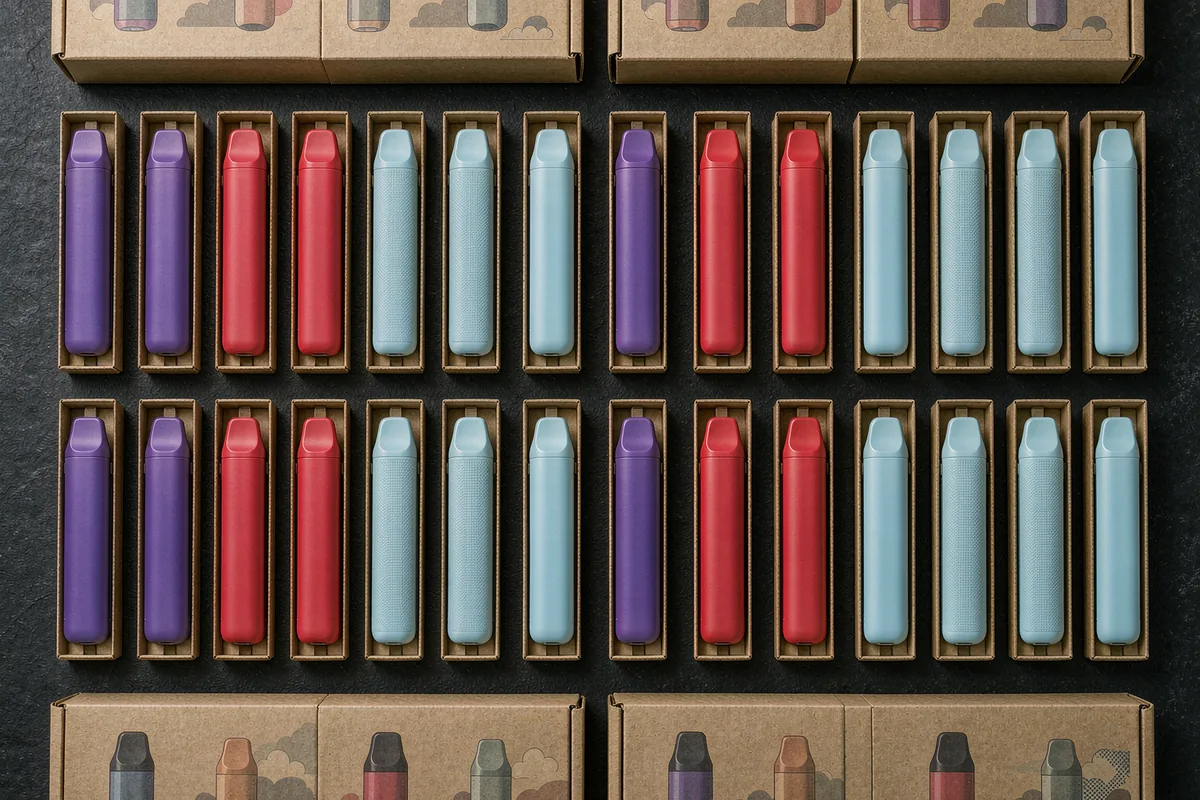
Mixed-flavour cartons let European retailers hit MOQ tiers without over-concentrating risk.
Minimum order quantity is one of the most misunderstood numbers in vape wholesale. Retailers often treat MOQ as an obstacle to be negotiated down, while experienced buyers treat it as a structural signal about how a supplier’s warehouse, carton configuration and pricing ladder actually work. This guide explains how to read MOQ, how to build mixed-flavour orders that sell through, and how to protect cash flow while doing it.
What MOQ actually measures
An MOQ is not an arbitrary gate. It usually reflects one of four operational realities:
- Carton and pallet configuration. Goods are picked in inner boxes and outers. Asking a warehouse to break an outer box costs handling time and slows dispatch for everyone.
- Pricing tiers. Volume bands exist because freight, pick-and-pack and payment processing costs are largely fixed per order.
- Regulatory handling. Every SKU carries a compliance file, artwork version and notification reference. More SKUs per order means more documentation checks before dispatch.
- Working capital. A supplier holding EU stock has already financed that inventory and must turn it at a predictable rate.
Understanding which of these drives your supplier’s MOQ tells you what is genuinely negotiable. A supplier constrained by carton configuration will usually flex on mix — you can meet the volume threshold with any combination of flavours.
The three MOQ structures you will meet in the EU market
Per-SKU MOQ
A minimum number of units for each individual flavour or model. This structure suits retailers with deep, narrow assortments — a shop that knows its top three flavours move predictably. The downside is cash concentration: a slow-moving flavour line can lock up budget for months.
Per-order MOQ with free mixing
A single total-unit threshold that can be met with any combination of SKUs. This is the most retailer-friendly structure in the current EU market, because it lets you spread risk across flavours while still hitting the pricing band that unlocks better terms.
Container or pallet MOQ
Used mainly for direct imports and private-label programs. Container-level buying offers the lowest unit cost but exposes you to the longest cash cycle, import clearance obligations and, in several member states, excise and packaging-registration duties.
Mixed-flavour buying: the mechanics that protect your margin
Mixed-flavour orders are the single most effective way for a European retailer to buy at volume without over-concentrating risk. The logic is straightforward: flavour preference varies sharply by market, by region and even by neighbourhood, and it shifts. Locking an entire pallet into one flavour is a bet; splitting that pallet across eight flavours is a portfolio.
Build a four-tier flavour matrix
Divide every order across four buckets, weighted by how predictable each is:
- Core (roughly 40%): your three to five highest-velocity flavours. These should never be out of stock.
- Secondary (roughly 30%): proven performers with slightly higher variance. Restock on a regular cycle.
- Test (roughly 20%): two to four new or seasonal lines. Buy one inner box each.
- Buffer (roughly 10%): reserved cash for an unexpected spike on a core SKU.
This split keeps the majority of your capital in proven lines while still letting you respond to demand shifts.
Watch the flavour-name risk
Flavour regulation across the EU is fragmenting. Some member states already restrict sales to tobacco and menthol variants, while others are phasing in broader restrictions on fruit, dessert and beverage flavours on national timetables. A harmonised EU-wide approach to flavour rules is one of the areas under discussion in the current TPD revision, but no single EU-wide flavour list is in force today.
The commercial consequence for buyers is simple: do not let any single flavour category carry more than roughly a quarter of your open stock position, and keep a written record of which SKUs are permissible in which markets. Mixed-flavour buying is as much a regulatory hedge as a merchandising tactic.
Weight the mix by device format, not only by flavour
A mixed order should also balance formats — for example, 2 ml prefilled disposable devices alongside rechargeable pods and refillable kits. If national rules tighten on one format in a market you serve, a balanced order lets you redirect stock instead of writing it off.
Pricing tiers: how to negotiate without damaging the relationship
- Ask for the band structure, not a discount. Knowing the unit thresholds between tiers lets you plan several orders ahead and consolidate them.
- Consolidate orders. Two half-size orders usually cost more in freight and handling than one full order at the next tier.
- Trade commitment for terms, not for price alone. A reliable payment schedule and a predictable reorder rhythm are worth more to a supplier than a one-off discount request, and they often earn you better allocation when stock is tight.
- Confirm what "price" includes. State the Incoterm. DAP and DDP are not interchangeable, and the gap widens once excise and import VAT enter the picture.
Running a trial order properly
A trial order has one purpose: to test execution. Judge it on dimensions you can actually measure.
- Carton condition and pallet stability on arrival.
- Label accuracy: market-language warnings, batch coding, artwork version.
- Unit-level quality: charging, draw consistency, leak checks on a sample.
- Dispatch and transit time versus the quoted figures.
- Documentation completeness — invoice, packing list, compliance references.
Record the results. Suppliers who pass this test reliably are worth committing to; suppliers who fail it once will usually fail it again during your peak season.
Cash-flow discipline for bulk buying
Bulk buying is only profitable if the stock converts into cash inside your planning horizon. Two rules keep that discipline intact.
First, cap slow movers. Set a maximum value or unit count for any SKU that has not proven itself over one full quarter. Second, set a rotation review. Every month, review which SKUs have been on the shelf for more than 60 days and stop reinvesting in them — reallocate that budget into the core bucket.
FAQ
Can I mix flavours to reach an MOQ?
Most EU-warehouse suppliers allow free mixing within a total unit or value threshold, which is exactly why the mixed-flavour approach works. Always confirm whether the threshold is counted in units, cartons or order value — the three produce very different basket sizes.
Is a higher MOQ always a worse deal?
No. A higher MOQ that unlocks a materially lower landed cost per sellable unit can be the better commercial decision, provided your sell-through data supports the volume and the stock is stable in your market.
Conclusion
MOQ is a design constraint, not a hurdle. Read it as information: it tells you how your supplier’s warehouse and pricing actually operate. Then structure every order as a weighted portfolio of formats and flavours, keep the majority of capital in proven lines, and test suppliers with measurable trial orders before you scale. That combination is what turns bulk buying from a cash-flow risk into a genuine margin advantage.
📘 Practical guides for EU B2B vape buyers
- EU Vape Wholesale Guide — A Practical Playbook for B2B Buyers in 2026
- TPD Compliance for Vape Distributors — A 2026 Field Guide
- Vape Bulk Pricing Economics — Where Margin Actually Lives
Looking to source 200+ disposable SKUs from EU warehouse stock? Open a wholesale account · talk to sales.