
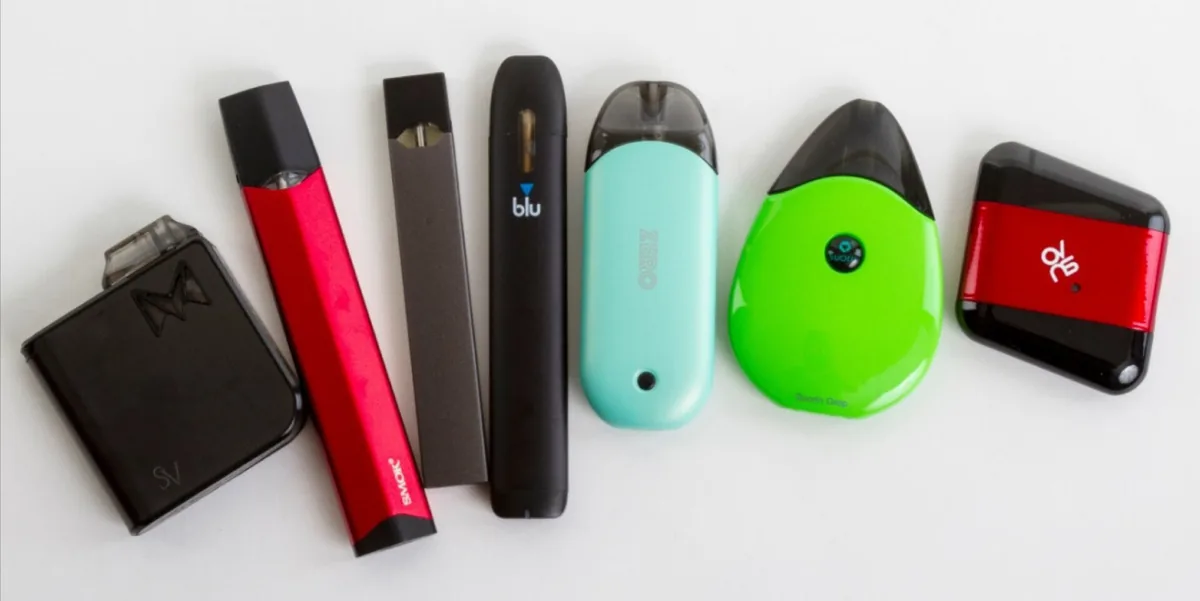
Real pod-mod devices photographed on a white background — the format mix that drives wholesale volume in the EU. (Photo: California Department of Public Health, via Wikimedia Commons — public domain.)
Ask ten European retailers which disposable vape they sell most and you will get ten different product names — but the same underlying formats. That is the useful way to read this market. Brand names rotate; formats persist, because formats are what customers actually ask for at the counter. This guide ranks the disposable and near-disposable formats that are generating wholesale volume in the EU in 2026, and sets out the parameters to verify before you commit shelf space.
How the EU market shapes the "bestseller" list
Three constraints define which models can sell at volume in the EU at all:
- Nicotine concentration capped at 20 mg/ml and e-liquid volume capped at 2 ml for single-use devices, cartridges and tanks under the TPD framework.
- Market-by-market category rules. Several member states have banned or restricted single-use devices, and others are moving in that direction, so the same model can be a bestseller in one country and unsellable in the next.
- Flavour restrictions. Some markets permit only tobacco or tobacco and menthol variants, which compresses the assortment to a narrow compliant subset.
A European "bestseller list" is therefore really a list of format archetypes sized to local rules, ordered below by the volume they typically represent in EU-warehouse catalogues.
1. Standard prefilled disposable — the volume base
The workhorse of the category. A sealed device, non-refillable, in the 2 ml class, typically delivering a few hundred draws and available across a wide flavour matrix where local rules allow.
- Why it sells: low unit price, no learning curve, easy gift or trial purchase, simple display logic.
- Best for: markets without additional national flavour restrictions; convenience-led retail; high-traffic counters.
- Buyer checks: chamber sealing and leak rates; draw consistency across the batch; artwork compliant with the latest national warning template.
2. Rechargeable disposable with Type-C port — the fastest-growing format
A disposable that adds a rechargeable battery, so the device is not discarded while e-liquid remains. In the EU this format has become the default upgrade for adult customers moving away from the simplest prefilled devices, and regulators’ attention to environmental impact has reinforced interest in rechargeable designs.
- Why it sells: better value perception, more consistent performance to the end of the e-liquid, strong repeat-purchase behaviour.
- Best for: retailers whose customers have already used standard disposables and are looking for a step up.
- Buyer checks: battery safety documentation; USB-C charging consistency; charge-while-vaping performance; indicator accuracy.
3. 2-in-1 dual flavour devices — highest margin per shelf facing
Two flavour chambers or two prefilled pods in one body, with a selector to switch. This format has become a staple in EU vape shops because it covers two flavour propositions in a single display facing and lifts average transaction value.
- Why it sells: variety within a tightly limited liquid volume; easy counter demonstration; fewer SKUs to manage.
- Best for: specialist vape stores with staff who can explain the switch mechanism.
- Buyer checks: genuine chamber separation, switch durability over repeated cycles, flavour pairing legality in each market.
4. High-capacity prefilled device — the performance tier
A larger-body prefilled device aimed at experienced adult users who want fewer device changes. Where local rules permit, these units are sold as larger-format disposable products; where they are not, the equivalent proposition is delivered through compliant rechargeable designs.
- Why it sells: fewer replacements per month, higher price point, strong loyalty once a flavour is established.
- Best for: markets with no additional restriction on single-use or large-format devices.
- Buyer checks: exact e-liquid volume and nicotine concentration in the configuration placed on the market; local category legality; carton configuration against your shelf-replenishment cycle.
5. Prefilled pod systems — the compliant-growth format
A rechargeable device body with replaceable prefilled pods. Not a disposable, but increasingly purchased alongside disposables by the same buyers.
- Why it sells: lower running cost for the customer, repeat pod sales for the retailer, and a design profile that fits tighter regulatory direction.
- Best for: markets with existing or expected single-use restrictions; retailers planning a two- to three-year product mix.
- Buyer checks: pod-to-body compatibility across your catalogue; unit margin on the pod compared with the device; coil life consistency.
6. Refillable kits and 10 ml e-liquids — the long-cycle category
Open systems and TPD-compliant refill containers.
- Why it sells: highest margin on repeat consumables; attracts experienced users; immune to single-use bans.
- Best for: markets with flavour restrictions that still permit refills, and retailers building a durable base of repeat customers.
- Buyer checks: 10 ml volume limit and 20 mg/ml cap; child-resistant and tamper-proof packaging; leaflet and warning compliance.
Specification checklist for any model you list
Before adding any line to your catalogue or shelf, confirm the following for each market you serve:
- Nicotine concentration at or below 20 mg/ml.
- E-liquid volume within the applicable TPD limit for the device configuration.
- EU-CEG notification reference, plus national filing where required.
- Child-resistant and tamper-proof construction, with information leaflet.
- Health warnings in the destination market’s language(s), on current approved artwork.
- Product category permitted in the destination market.
- Flavour permitted in the destination market.
- Battery safety documentation on file.
- Carton and inner-box configuration confirmed against your shelf cycle.
- DOA rate and claims process confirmed in writing.
What to watch for the rest of 2026
The current TPD revision process is the biggest variable in EU assortment planning. The Commission’s evaluation work and public consultation have put harmonised flavour rules, product standards for single-use devices, recycling and take-back obligations, and plain packaging on the table. A formal legislative proposal is expected to follow the consultation phase, with parliamentary review running into 2027 and implementation likely later in the decade.
For wholesale buyers, the planning implication is unchanged and unambiguous: keep a mixed format portfolio, avoid over-concentration in any single device category, and treat regulatory flexibility — not the lowest unit price — as the priority when choosing which models to stock deep.
FAQ
Which disposable vape format sells best in the EU right now?
Standard prefilled devices still represent the largest volume, but rechargeable Type-C disposables and 2-in-1 dual flavour devices are the fastest-growing lines in most EU-warehouse catalogues. The answer also depends on your market’s category and flavour rules.
Are high-puff disposables legal in the EU?
The TPD framework caps nicotine concentration and e-liquid volume per device rather than puff count. A device complies only if it stays within those limits in the configuration placed on the market, and some member states additionally restrict or ban single-use devices entirely. Always check the destination market first.
Conclusion
Europe’s disposable vape bestseller list is a moving target driven by regulation as much as by taste. The formats that keep selling share three traits: they stay inside the TPD parameters, they suit the flavour assortment their market permits, and they make a retailer’s shelf and inventory more productive. Build your 2026 catalogue around those three tests, keep a mixed format portfolio, and revisit the list every quarter as national rules and the TPD revision continue to move.
📘 Practical guides for EU B2B vape buyers
- EU Vape Wholesale Guide — A Practical Playbook for B2B Buyers in 2026
- TPD Compliance for Vape Distributors — A 2026 Field Guide
- Vape Bulk Pricing Economics — Where Margin Actually Lives
Looking to source 200+ disposable SKUs from EU warehouse stock? Open a wholesale account · talk to sales.