
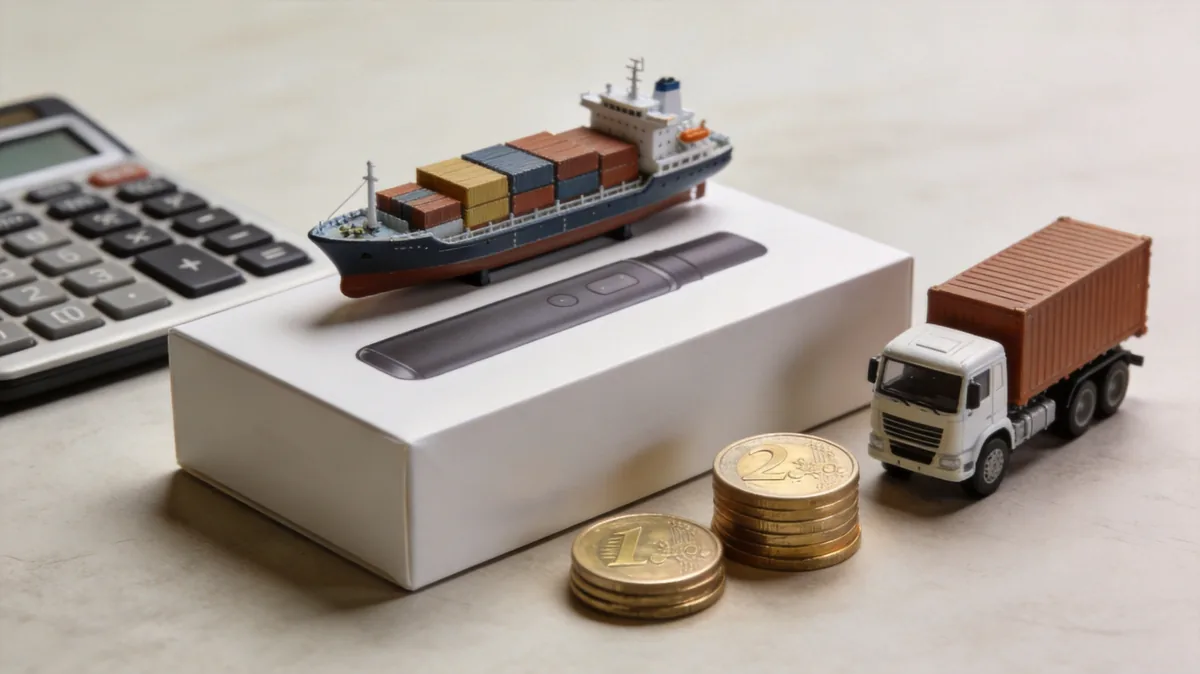
The unit price on a quote is the start of the maths, not the end. The real landed cost of a vape SKU includes the purchase price, the tax you pay and may recover, freight, breakage, and the cost of cash sitting in slow stock. This article breaks the pieces down so your margin estimates stop lying to you, and shows where a看上去 healthy gross margin quietly shrinks.
Start from the invoice price, not the sticker
Your cost of goods is the unit price on the proforma invoice at the tier you reached. If you mixed flavours to hit the 50 to 99 tier, use that tier price, not the 10 to 29 price, when you calculate margin. Many buying mistakes start by comparing retail price to the highest listed unit cost instead of the actual paid cost.
Because tiers drop the per-piece cost as volume rises, the same SKU has a different landed cost depending on how you ordered it. Always anchor your maths to the price you actually paid, which means recording the tier on every order.
VAT and input tax: paid, then usually recovered
In B2B trade within the EU, VAT is normally charged on the invoice and then recoverable as input tax if you are a VAT-registered business. For most registered buyers that makes VAT a pass-through, not a permanent cost, because you reclaim it rather than absorb it. The key word is “if”: recovery depends on your own registration and local rules, so confirm the mechanics with your tax authority or accountant before you treat VAT as free.
This is a factual description of common VAT mechanics, not a promise about your situation. Local rules differ, and they change, so verify rather than assume.
Shipping and the 3 to 5 day window
Freight from a European warehouse is either included or quoted per order. Either way, spread it across the units you received to get a per-SKU shipping cost. Faster delivery also carries a hidden benefit: less of your cash is sitting in transit, which lowers the opportunity cost we cover later.
The shipping and delivery page lays out the payment-to-delivery timeline, which helps you predict when stock arrives and when the cash comes back as sales.
Breakage and dead stock: the silent leaks
A few broken units per batch are normal in physical retail, and each one is a 100 percent loss on that piece. Build a small breakage allowance into your cost model so a cracked device does not quietly erase margin you thought you had. Dead stock is the larger leak: a SKU that does not move ties up the cash and the shelf space of several fast sellers.
Low minimum orders help here directly. Because you can order 10 pieces instead of a large carton, a slow flavour costs you ten units of lesson rather than a pallet of mistake. That is why MOQ 10 is not just a convenience but a margin protector.
Cash occupation cost
Money tied in slow stock has an opportunity cost: it could have earned a return or backed a faster-selling SKU. Even a modest monthly cost of capital, applied to the days a unit sits before sale, adds to landed cost. Fast-turning stock therefore has a lower true landed cost than the same unit sitting for two months, even at the identical invoice price.
A simple way to feel this: if a slow SKU ties up 300 euros for eight weeks, and your cash could otherwise support a faster SKU that returns its cost in two weeks, the slow unit is not just earning less, it is blocking three or four turns of good stock. That blocked turnover is a real cost, even though it never appears on the supplier’s invoice. Counting it is what separates a margin estimate from a margin reality.
Margin is not a single number on the invoice. It is what remains after tax mechanics, freight, breakage, dead stock, and cash occupation are all counted.
Worked example: 40 percent gross can look like 20
The table below is an illustrative model with stated assumptions, not a claim about any specific product or market. It shows how a headline gross margin shrinks once the hidden pieces are counted. Replace the assumptions with your own numbers to model a real SKU.
| Step | Effect on one SKU |
|---|---|
| Unit price at paid tier | Base cost of goods |
| Plus per-unit freight | Small addition |
| Plus breakage allowance, say 2 percent | Small addition |
| Plus dead-stock buffer on slow movers | Varies by SKU speed |
| Plus cash occupation for days in stock | Small but real |
| Minus VAT recovered, if registered | Pass-through removed |
| Equals real landed cost | Higher than unit price |
In this model, a SKU that looked like a 40 percent gross margin at invoice price can land closer to 20 percent net once freight, breakage, a dead-stock buffer, and cash occupation are included, assuming VAT is recovered. If VAT is not recoverable for you, the gap is wider. The point is to plan the real number, not the sticker number.
Use tier pricing to push cost down
Climbing the volume tiers is the cleanest way to lower true landed cost, because a lower per-piece price reduces every later calculation built on it. The five tiers, 10 to 29, 30 to 49, 50 to 99, 100 to 199, and 200 plus, reward modest volume, and our supplier selection guide explains how to weigh tier depth against cash risk when choosing a partner.
Mixed-flavour cartons let you reach a higher tier without over-committing to one flavour, so you capture the lower unit cost while keeping the assortment flexible. That combination, low MOQ plus mixed cartons plus EU stock, is what keeps the real landed cost down for a small retailer.
Frequently asked questions
Is VAT always a recoverable cost?
For many VAT-registered EU businesses it is recoverable as input tax, which makes it a pass-through. Whether you can recover it depends on your registration and local rules, so confirm with your tax authority rather than assuming.
Why does a fast-selling SKU have lower landed cost?
Because less of your cash sits in it. Freight, breakage, and cash occupation are similar in amount, but the faster unit returns its cost as sales sooner, reducing the opportunity cost baked into the true landed cost.
How do tiers affect my margin?
Higher tiers lower the per-piece price you pay, which lowers cost of goods and therefore raises margin on every unit, provided you do not buy so much that dead stock rises. Mixed-flavour cartons help you reach tiers without that risk.
Where can I get help modelling my own costs?
The customer help page explains how to reach us, and we can walk through the tier math for your specific assortment so your margin estimates reflect real landed cost.
Ready to see the real landed cost of your assortment? Browse the wholesale shop to check tier prices, or message us on WhatsApp at https://wa.me/8617324671020 for a tier breakdown. We reply within one business hour on weekdays 09:00 to 18:00 CET.
📘 Practical guides for EU B2B vape buyers
- EU Vape Wholesale Guide — A Practical Playbook for B2B Buyers in 2026
- TPD Compliance for Vape Distributors — A 2026 Field Guide
- Vape Bulk Pricing Economics — Where Margin Actually Lives
Looking to source 200+ disposable SKUs from EU warehouse stock? Open a wholesale account · talk to sales.